When your Chromebook starts acting a little sluggish, an application freezes, or perhaps that new system update just doesn't feel quite "settled," there's one simple, often overlooked solution that works wonders: a restart. Far from a mere "turn it off and on again," Understanding Why and When to Restart Your Chromebook is key to maintaining its snappy performance and resolving a myriad of minor issues, ensuring you get the best results from your device. Think of it as a digital spring cleaning for your Chrome OS, a quick refresh that can breathe new life into your everyday computing experience.
At a Glance: Why and When to Restart Your Chromebook
- Why a restart helps: Clears temporary files, refreshes memory (RAM), closes stuck processes, and ensures updates are fully applied.
- When to restart: For sluggish performance, frozen apps, connectivity issues (Wi-Fi, Bluetooth), display glitches, or after a system update.
- How often: Regularly (e.g., once a week) or whenever you notice performance dips.
- Different methods: Quick Settings, Power button (standard or hard), Chrome URL (browser-only), or via update notification.
- Not just "off and on": Distinct from a full shut down (which clears more deeply) and a factory reset (Powerwash, which erases data).
The Digital Refresh Button: Why Your Chromebook Benefits From a Restart
Your Chromebook, for all its streamlined efficiency, is still a computer. Like any digital workhorse, it juggles countless tasks in its "mind" – running apps, browsing tabs, managing system processes, and downloading data. Over time, this constant activity can lead to a buildup of temporary files, cached data, and processes that don't quite shut down cleanly, even if you've closed the associated app. This digital clutter can hog your device's memory (RAM), slow down its processor, and ultimately degrade overall performance.
A restart acts like a quick, systematic reset button for the Chrome OS. It performs several crucial functions:
- Clears Temporary Memory (RAM): Running applications and browser tabs consume RAM. When you close them, sometimes the memory isn't fully released. A restart clears all active RAM, giving your Chromebook a fresh slate and freeing up resources for new tasks.
- Shuts Down Stuck Processes: An app might freeze or a background process might get stuck in a loop, consuming CPU cycles and slowing everything down. A restart forcibly closes all running processes, resolving these digital logjams.
- Removes Accumulated Temporary Files: While not a deep clean like a factory reset, a restart helps clear some temporary system files that can accumulate and cause minor conflicts.
- Re-establishes Connections: Wi-Fi, Bluetooth, and other peripheral connections can sometimes become flaky. A restart re-initializes these connections, often resolving transient connectivity issues.
- Finalizes Software Updates: Chrome OS updates often require a full restart to properly install and integrate new features or security patches. Without it, your system might be running a hybrid of old and new code, leading to instability.
In essence, a restart is your first line of defense against minor technical hiccups, preventing small annoyances from escalating into bigger problems. It's about maintaining that "new Chromebook" feeling and ensuring smooth, uninterrupted productivity.
When Your Chromebook Whispers "Restart Me": Common Scenarios
Recognizing the signs that your Chromebook needs a refresh is the first step toward proactive maintenance. Here are the most common situations where a quick restart can save you time and frustration:
Sluggish Performance and General Slowdown
This is perhaps the most frequent reason. If your Chromebook, usually a speed demon, starts feeling like it's wading through molasses – apps take longer to open, web pages load slowly even with a good connection, or switching between tabs feels delayed – it's a prime candidate for a restart. This usually signals an accumulation of temporary files or too many active processes silently hogging resources.
Frozen Applications or an Unresponsive Device
You're in the middle of a crucial document, and suddenly your browser tab stops responding. Or worse, the entire device freezes, ignoring your trackpad clicks or keyboard inputs. Before panic sets in, try a restart. It's often enough to unstick a frozen application or revive an unresponsive system. Just be mindful that any unsaved work in frozen applications might be lost if you force a restart.
Connectivity Catches: Wi-Fi, Bluetooth, and Peripherals
Imagine your Wi-Fi suddenly drops, or your Bluetooth headphones refuse to connect, even though other devices are working fine. Connectivity issues, whether with your internet, Bluetooth accessories, or external monitors, can often be resolved with a simple reboot. The restart cycle allows the operating system to re-initialize these hardware modules and their drivers, often fixing temporary glitches that prevent them from connecting properly.
Display Glitches or Flickering Screens
Seeing strange visual artifacts, screen flickering, or incorrect resolutions? While more serious display issues might point to hardware problems, minor graphical hiccups can often be attributed to temporary software conflicts or driver issues. A restart clears these up, allowing the display drivers to reload cleanly.
Post-Update Protocol: Ensuring New Software Settles In
Google frequently rolls out updates for Chrome OS, bringing new features, security enhancements, and performance improvements. While your Chromebook will usually prompt you to restart after an update has downloaded, it's crucial not to ignore this. Restarting ensures that all the new system files are fully integrated and that your device is running the latest, most stable version of Chrome OS. Skipping this step can lead to unexpected behavior or prevent new features from working correctly.
Before Contacting Support: The First Troubleshooting Step
If you're facing any persistent, unexplained issue with your Chromebook, a restart should always be your very first troubleshooting step. It's the equivalent of checking if a device is plugged in before calling an electrician. Often, what seems like a complex problem is just a temporary software snag that a fresh boot can resolve. Only if the issue persists after a restart should you consider more advanced troubleshooting or reaching out for technical assistance.
How to Restart Your Chromebook: A Quick Guide to Every Method
Fortunately, restarting your Chromebook is straightforward, and Chrome OS offers a few different paths depending on your situation. Here’s how you can perform a restart, from the standard quick refresh to an emergency hard reset. For a more detailed, step-by-step visual walkthrough of these methods, you might want to check out our comprehensive guide on how to restart your Chromebook.
1. The Standard Restart: Via Quick Settings/Shelf
This is the most common and safest method for a standard restart. It gives Chrome OS a chance to shut down gracefully, minimizing the risk of data loss.
- How to do it:
- Click on the status area (the bottom-right corner of your screen showing the time, battery, Wi-Fi icon, etc.). This opens the Quick Settings panel.
- Locate the power icon (often a circle with a vertical line, like a traditional power button symbol).
- Click the power icon. A small menu will appear.
- Select "Restart." Your Chromebook will shut down and then power back on automatically.
2. The Standard Restart: Via Power Button
This method is also very common and works well when your trackpad or keyboard might be partially unresponsive, but the system isn't completely frozen.
- How to do it:
- Press and hold the Power button on your Chromebook for a few seconds (usually 1-2 seconds).
- A small menu should appear on your screen with options like "Shut down" and "Restart."
- Select "Restart."
3. The Emergency Restart: Via Power Button (Hard Restart for Frozen Devices)
This is your last resort for a completely unresponsive Chromebook. Use this only when the device is frozen solid and doesn't respond to any other input, as unsaved work might be lost.
- How to do it:
- Press and hold the Power button firmly for 10-15 seconds. Your Chromebook will forcefully shut down without the usual graceful closing of applications.
- Once the screen goes black, release the Power button.
- Wait a few seconds (e.g., 5-10 seconds).
- Press the Power button again briefly to turn your Chromebook back on.
4. Browser-Only Restart: Via Chrome URL
Sometimes, the issue isn't with the entire operating system, but specifically with the Chrome browser itself or a web application running within it. This method restarts only the browser, leaving other background processes intact. It's quick and less disruptive if you suspect a browser-specific problem.
- How to do it:
- Open the Chrome browser.
- Type
chrome://restartinto the address bar. - Press Enter.
- The browser will close all its tabs and windows, then relaunch. Your previous tabs will likely restore if your browser settings are configured for it.
5. Post-Update Restart: Via Update Notification
When a new Chrome OS update has downloaded, your Chromebook will typically notify you that a restart is required to complete the installation.
- How to do it:
- Look for an "Update" icon (often a small upward-pointing arrow or similar indicator) in the bottom-right shelf near the time.
- Click on this Update icon.
- Select "Restart to Update." Your Chromebook will restart, install the update, and then boot back up.
Beyond the Reboot: Understanding Restart vs. Shut Down vs. Reset
While "restart," "shut down," and "reset" are all actions that involve powering down your Chromebook, they serve distinct purposes and have different impacts on your device and data. Understanding these differences is crucial for effective troubleshooting and device management.
Restarting: The Quick Refresh
- What it does: Closes all running applications and processes, clears temporary memory (RAM), and reloads the Chrome OS from a clean state. It's a quick cycle of turning off and then immediately turning back on.
- When to use it: For minor glitches, sluggish performance, after software updates, resolving connectivity issues, or when an app freezes. It's your go-to for daily maintenance.
- Data impact: Minimal. Any unsaved work in open applications might be lost, especially if the device was frozen. Otherwise, your files and settings remain untouched.
Shutting Down: The Deep Rest
- What it does: Powers off your Chromebook completely. Unlike a restart, it doesn't immediately power back on. It clears even more cached system data and ensures all components are fully powered down.
- When to use it: When you won't be using your Chromebook for an extended period (e.g., overnight, during travel). It's also beneficial for resolving more persistent but minor issues that a quick restart didn't fix, as it provides a deeper system clear. It can also help conserve battery life if you're storing the device for a while.
- Data impact: No data loss if performed properly. All open applications are closed, so save your work beforehand.
Resetting (Powerwash): The Factory Reset
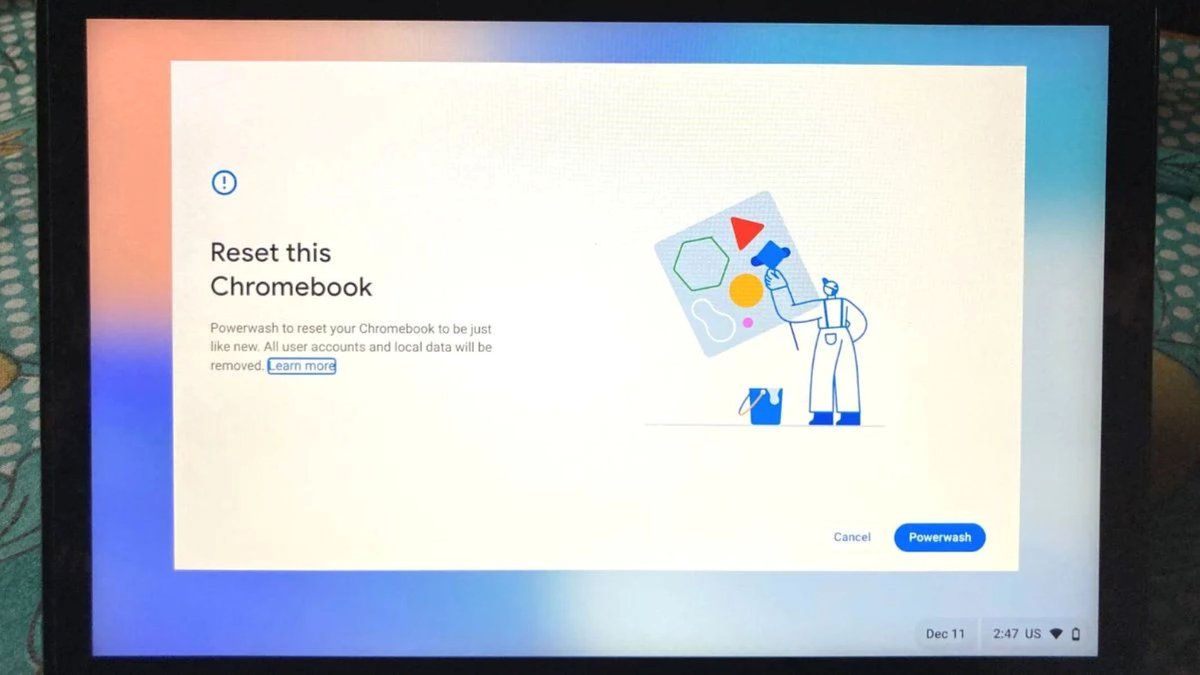
- What it does: Also known as a "Powerwash," this is a drastic step that restores your Chromebook to its original factory settings. It essentially wipes your device clean, deleting all user accounts, local files, installed apps, and customized settings. It then reinstalls a fresh copy of Chrome OS.
- When to use it: For serious, persistent software issues that no other troubleshooting step (restarts, updates, closing apps) has resolved. It's also recommended when preparing to sell, donate, or give away your Chromebook, or if you suspect a serious malware infection that can't be otherwise removed. If you're encountering issues that seem beyond typical fixes, a comprehensive guide to performing a Powerwash or factory reset could be invaluable.
- Data impact: All data will be erased. This includes all files in your Downloads folder, locally installed Android apps, and custom settings. Files synced to Google Drive will be safe, but anything stored only locally will be gone. Always back up important data to Google Drive or an external drive before performing a Powerwash. For users who rely heavily on local storage, understanding Chromebook privacy settings might offer additional insights on data management before such a drastic step.
| Feature | Restart | Shut Down | Reset (Powerwash) |
| :---------- | :------------------------------------------- | :--------------------------------------------- | :------------------------------------------------------- |
| Purpose | Quick refresh, resolve minor glitches | Complete power cycle, extended non-use | Erase all data, restore factory settings |
| Process | Off-on cycle | Off, then manual on | Off, wipe data, re-install OS, then manual on |
| Data Loss | Unsaved work in open apps | None (if saved work) | All local data erased (back up first!) |
| Time | Fast | Moderate | Slow (includes OS reinstallation) |
| Frequency | Daily/weekly, as needed | Nightly, extended breaks | Last resort for severe issues, device transfer |
When a Restart Isn't Enough: Next Steps for Stubborn Issues
While a restart is a powerful first step, some issues are more deeply rooted. If your Chromebook continues to misbehave after a good reboot, don't despair. Here are the next logical troubleshooting steps to explore:
- Check Your Internet Connection and Router: Sometimes, what appears to be a Chromebook issue is actually a network problem.
- Test other devices: See if your phone or another computer can access the internet on the same Wi-Fi network.
- Restart your router/modem: Unplug your Wi-Fi router and modem from power for 30 seconds, then plug them back in. Wait a few minutes for them to fully boot up before trying your Chromebook again.
- Forget and reconnect Wi-Fi: On your Chromebook, go to Quick Settings, click the Wi-Fi icon, select "Networks," then "Known networks." Find your Wi-Fi network, click the three dots, and choose "Forget." Then, try to reconnect to the network as if for the first time.
- Close Unnecessary Browser Tabs and Applications: Even if your Chromebook isn't frozen, too many open tabs, especially those with media or complex scripts, can consume significant resources.
- Close any tabs you're not actively using.
- Close Android or Linux apps running in the background if you don't need them.
- Use the
Shift + Esckeyboard shortcut to open the Chrome OS Task Manager, which shows you which tabs and processes are consuming the most memory and CPU. You can end processes from here. For a deeper dive into optimizing your Chromebook's performance, this step is crucial.
- Update Your Apps: Outdated Android apps can sometimes cause conflicts or performance issues.
- Open the Google Play Store on your Chromebook.
- Click on your profile picture (top right).
- Select "Manage apps & device."
- Go to the "Updates" tab and choose "Update all" or update individual apps.
- Perform a Powerwash (Factory Reset): As detailed earlier, if all else fails and you're still experiencing severe, unresolvable issues, a Powerwash can be the solution. Remember, this will erase all local data, so back up everything important to Google Drive or an external storage device beforehand. This step is a last resort before considering hardware issues.
- Contact Google Support: If you've tried all the above steps, including a Powerwash, and your Chromebook is still malfunctioning, it's time to reach out to Google Support or the manufacturer of your device. There might be a deeper software bug or even a hardware issue that requires professional attention. Sometimes, it might require an advanced Chromebook troubleshooting guide or direct human assistance.
Best Practices for a Healthy and Happy Chromebook
Maintaining your Chromebook's peak performance is less about complex technical maneuvers and more about consistent, simple habits. Integrating regular restarts into your routine is a cornerstone of this approach.
Establish a Regular Restart Routine
Just as you might give your car an oil change, your Chromebook benefits from routine maintenance. Aim to restart your Chromebook at least once a week, even if you don't notice any immediate performance issues. This preemptive refresh clears out accumulated clutter before it can cause noticeable slowdowns or glitches. Many users simply restart their device at the end of their workday on Friday, or every Sunday evening, allowing it to start the new week fresh.
Prioritize System Updates
Chrome OS is designed for continuous improvement through regular updates. Don't defer or ignore update notifications. These updates not only bring new features but also crucial security patches and performance optimizations. Always allow your Chromebook to install pending updates and restart when prompted to ensure you're running the most secure and efficient version of the operating system.
Be Mindful of Tab and App Overload
While Chromebooks are efficient, they're not limitless. Running dozens of browser tabs simultaneously, especially those with heavy scripts, video, or animations, combined with multiple Android or Linux apps, can strain even the most capable device. Develop the habit of closing tabs and applications you're not actively using. Bookmark important pages rather than keeping them open indefinitely.
Practice Good Digital Hygiene
Beyond restarting, a few other habits contribute to your Chromebook's longevity and performance:
- Periodically clear browsing data: While a restart helps, occasionally clearing your browser's cache, cookies, and history can free up storage and resolve website-specific loading issues.
- Manage extensions: Too many browser extensions can slow down your browser. Review your installed extensions and remove any you don't frequently use.
- Check storage: While Chromebooks rely heavily on cloud storage, your Downloads folder can accumulate files. Periodically review and clear out unnecessary local files.
Your Chromebook, Refreshed and Ready
Think of your Chromebook as a high-performance athlete. Even the best need rest and recovery to perform at their peak. A simple restart is your Chromebook's way of stretching, clearing its head, and getting ready for the next challenge. By understanding why a restart is beneficial and when to perform it, you empower yourself to quickly resolve common issues, keep your device running smoothly, and extend its useful life. Make it a regular part of your digital routine, and enjoy the consistently snappy, reliable experience your Chromebook was designed to deliver.